Understanding Computer Architecture Through the Wheat Processing Analogy
Computers are often perceived as complex systems filled with intricate circuits and abstract digital processes. However, I’m not trying to teach a college course in computer science here, I’m hoping that by the process of processing wheat through the mill in the barn to become the final flour will simply give you an idea of how computers work, rather than very deep logical principles.if we break down their fundamental operations, we can liken them to a traditional wheat processing system, which transforms raw wheat into flour. This analogy provides an intuitive way to understand how computers process information, from input data to output storage.
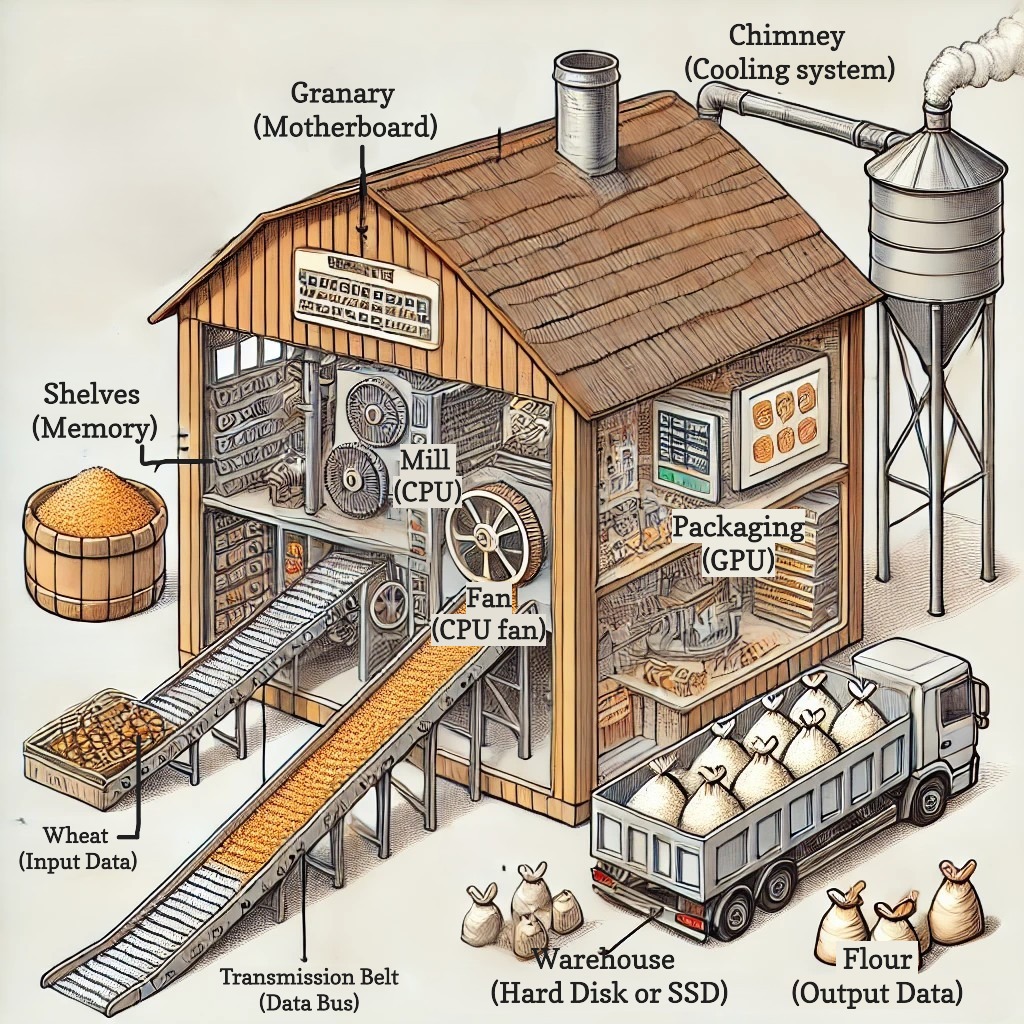
1. Wheat as Input Data
Every computing process starts with input data, just as flour production begins with raw wheat. In a computer, this input data could be anything from numbers entered through a keyboard to complex image files or sound. Similarly, in a flour mill, different types of wheat are used as raw materials depending on the desired product.
2. Transmission Belt as Data Bus
Once the wheat is harvested, it needs to be transported to the granary for storage and processing. This transport occurs via a transmission belt, which moves the wheat efficiently within the system. In a computer, the equivalent component is the data bus, which transfers data between different hardware components such as memory, the central processing unit (CPU), and storage devices. Just as a transmission belt ensures a steady flow of wheat, the data bus ensures smooth and fast communication between the different parts of a computer.
3. Granary as the Motherboard
The granary serves as the central hub where the wheat is collected, organized, and prepared for further processing. In a computer, this role is played by the motherboard. The motherboard connects all key components, including the CPU, memory, and storage, ensuring seamless interaction. Just as the granary is essential for storing and managing wheat before processing, the motherboard is fundamental to coordinating data flow and device communication.
4. Mill as the CPU (Central Processing Unit)
The heart of the wheat processing system is the mill, where wheat is ground into flour. This grinding process is equivalent to the CPU’s function in a computer. The CPU is responsible for executing instructions, performing calculations, and processing raw data into meaningful information. Just as different mills operate at varying speeds and efficiency levels, CPUs also differ in terms of processing power, measured in clock speed and core count. Faster and more powerful CPUs can process data more efficiently, just as an advanced mill can produce flour more quickly.
5. Shelves as Memory (RAM)
During processing, intermediate wheat products, such as coarse flour or partially milled grains, are placed on shelves before further refinement. These shelves represent the memory (RAM) in a computer, which temporarily stores data that the CPU is actively working on. RAM provides quick access to necessary information, much like shelves ensure that partially processed wheat is readily available for the next stage of milling. However, RAM is not a permanent storage solution—once power is lost, the data is cleared, just as perishable wheat products may deteriorate if left unused for too long.
6. Flour as Processed Output Data
Once the wheat has been fully milled, it transforms into flour, which represents processed data in a computer system. Just as flour is the final product used in baking and cooking, processed data is used in applications, computations, and visual outputs. The transformation of raw wheat into flour mirrors how input data is refined into meaningful output.
7. Warehouse as Storage (Hard Disk or SSD)
After processing, flour must be stored in a warehouse before distribution and use. In a computer, this storage function is handled by hard drives or solid-state drives (Harddisk or SSDs). Storage devices retain processed data permanently, allowing users to access it later. Similar to a warehouse’s organization and capacity, storage devices vary in size and performance, affecting how much data can be stored and how quickly it can be retrieved.
8. Packaging as the GPU (Graphics Processing Unit)
Before flour reaches consumers, it undergoes packaging and labeling, making it presentable and easy to distribute. This process is similar to how a GPU (Graphics Processing Unit) works in a computer. The GPU takes processed data and renders it into visual formats, whether for gaming, video editing, or general display output. Just as different packaging methods affect flour’s usability and market appeal, GPUs vary in performance, determining how efficiently and beautifully visuals are rendered. High-end GPUs provide smoother, more detailed graphics, much like premium packaging enhances product presentation and usability.
Conclusion
The process of processing wheat into flour is analogous to the processing of a computer, which shows the functions of the various components of a computer in a very concrete way. It is easy for you to understand the role and function of each component in the computer assembly process.